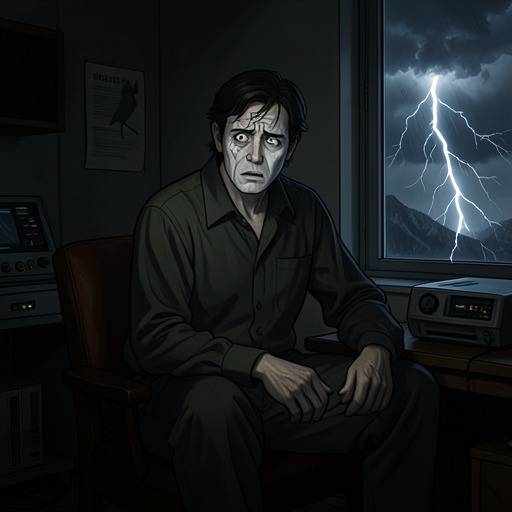
Silence as abandonment
A cataclysmic lack of HarmonySilence as abandonment names the emotional and relational condition in which a former bond remains psychologically present while communication has ceased to provide contact. Across the book, silence is represented as departure, indifference, failed speech, and an enclosing emptiness: the absent other is still addressed, remembered, imitated, and desired, yet no answer arrives. Its decisive significance lies in this contradiction. The speaker is not simply alone; the speaker is left alone inside the remains of a relationship that once filled the room with laughter, making every later word measure the distance from that earlier warmth.
Definition and Emotional Structure
Silence first appears as a total deprivation of orientation. No light can be seen, and the speaker is compared to a sailor fighting storms and seas while constantly in danger. The image makes abandonment an environment rather than a single act: the person left behind must continue moving through conditions in which guidance and safety have disappeared. The darkness is therefore both external and relational, a space where the absent other cannot be reached and where the speaker cannot reliably locate a way forward.
The central declaration is stark: “Alone,” followed by the accusation that the other person left the speaker. Abandonment is then recast as an “eternal and impossible war” fought through the flames of the other’s disinterest. The language gives silence an adversarial force. It burns, exhausts, and leaves the speaker breathless, while the conflict remains impossible because it is conducted without reciprocal engagement. The injury is not merely that conversation has stopped; it is that indifference has replaced the mutual presence that would make conflict resolvable.
From Shared Speech to Empty Remnants
The remembered past establishes what has been lost. The two people once talked “for days and days,” filling the room with warm, timeless laughter. That recollection turns the present silence into a measurable transformation rather than an original state. The room survives as an implied site of intimacy, but its former sound has become the standard against which the current absence is felt.
The relationship’s decline is rendered through shrinking language. What remains is “nothing left but silent monosyllables,” and even those fragments are fading into the cold darkness of empty memories. The movement from extended conversation to monosyllables is also a movement from shared time to damaged recollection. Speech has not simply become less frequent; it has lost its capacity to sustain a common world. The adjective “silent” attached to the monosyllables produces a paradox in which language remains visibly present while communication has already collapsed.
The speaker nevertheless continues to address the absent person, talking as if that person were still there and asking why such breath is being wasted. This imagined exchange exposes the circular structure of abandonment: the speaker knows the address may be futile, yet continues speaking because silence itself has become unbearable. The voice reaches toward an interlocutor who exists as memory, expectation, or absence, and the act of speaking becomes evidence of the bond’s persistence as well as its failure.
Withdrawal, Fear, and Repeated Return
Silence also governs the speaker’s bodily and psychological retreat. The speaker recalls having to pretend while the other person’s arms were entangled with the speaker’s, then running away before losing the speaker’s mind. Intimacy is consequently double-edged: physical closeness does not guarantee emotional safety and may become the immediate condition from which escape is necessary. The recollection links abandonment to an earlier inability to remain honestly present, suggesting that silence is produced not only by the other’s departure but also by fear within the relationship.
The plea that follows is direct: “Say something,” because silence is a killer and the speaker is its favourite prey. This formulation turns noncommunication into a predatory force. The speaker is not describing quiet as relief or contemplation; silence actively consumes, selects, and threatens. The repeated demand for speech also shows the speaker’s dependence on an answer that may no longer be available. The more silence persists, the more urgently language is summoned, and the more visibly language fails.
A similar pattern appears in the image of the speaker silently imitating the other person. Day follows day and rain follows rain, until silence returns. Imitation preserves proximity while confirming separation: the speaker can reproduce the other’s outline or manner but cannot obtain a response. The scene is marked by fear of breaking empty promises, as though the relationship’s remaining commitments are hollow structures that must not be disturbed. Words then become worse than a thousand arrows, piercing the other’s solitary but golden heart. Speech has not vanished entirely, but it has become injurious, arriving too late or in a form that intensifies the wound.
Cosmic and Social Pressures
The concept extends beyond private abandonment into larger systems of emotional danger. The speaker describes being driven toward the precipice of Insanity while a compassionate heart is corroded. The relation between silence and abandonment is therefore not static: prolonged nonresponse changes the person who endures it, converting compassion into corrosion and psychological pressure into a limit experience. The apparent peacefulness that follows this description carries an unstable irony, because the calm is presented beside the threat of mental collapse rather than as its resolution.
The book also places desire against the chains of Heteronormativity. A wave of shared desires crashes against those chains, making social regulation resemble a material barrier that blocks emotional and erotic movement. In this context, silence can signify more than one person’s refusal to answer. It can be the imposed quiet surrounding a relationship that cannot easily speak itself within dominant norms. The private absence of dialogue and the public pressure of Heteronormativity reinforce one another: desire surges, but the structures around it convert expression into risk.
The recurring weather and disaster imagery gives this pressure a physical scale. The speaker carries a raging thunder inside, accompanied by a tornado of emotions consuming every part of a tormented soul. Internal feeling becomes weather that cannot be contained by ordinary speech. The storm recalls the earlier sailor fighting dangerous seas, so the book repeatedly maps psychic abandonment onto hazardous natural forces. Silence is the stillness after or within that storm, not proof that the storm has ended.
Final Form: Voice Without Reception
Near the end, the motif reaches its most stripped-down form. The speaker asks whether the voice can be heard, identifies the call as SOS, and describes inaudible sounds leaving the mouth. The communication system has become a distress signal whose urgency is clear to the speaker but whose transmission fails. The question of audibility is more fundamental than the question of reply: the speaker cannot even establish that a voice has crossed the distance.
The final images place this failed call inside a house taken over by emptiness. The house, once associated with days of conversation and warm laughter, has become the spatial embodiment of abandonment. The repeated SOS turns the ending into a loop of emergency rather than a completed resolution, while the question of being alive and the question of whether this is “the end before the end” push silence toward existential uncertainty. Silence as abandonment thus concludes not with reconciliation or confirmed death, but with a voice suspended between survival and disappearance.
As a literary concept, Silence as abandonment organizes the book’s central contrasts: darkness against the possibility of light, storms against stillness, remembered laughter against monosyllables, desire against social chains, and urgent speech against inaudibility. Its formal power comes from repetition and reduction. The text keeps returning to the same failed communicative scene, but each return changes its scale—from a broken conversation, to a dangerous intimacy, to social constraint, to a house emptied of meaning. Silence becomes the visible shape of a relationship that has not emotionally ended even while its mutual language has disappeared.